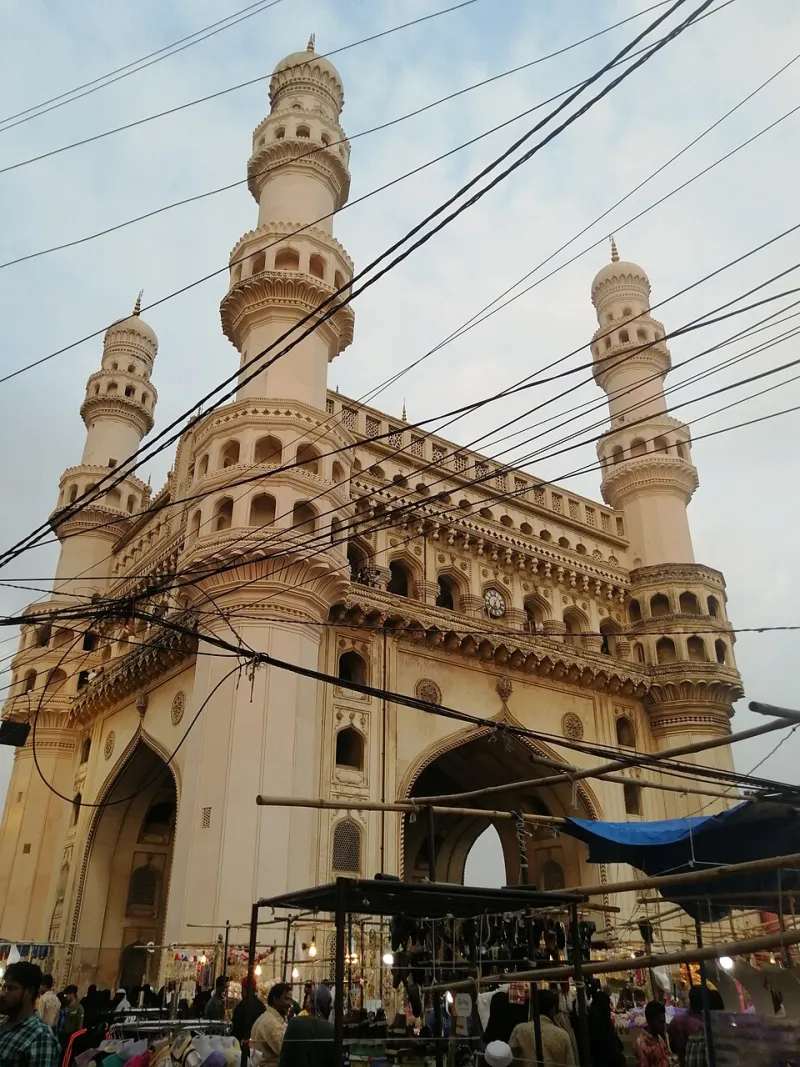
After Dark in the City of Pearls: The Nocturnal Markets Where America's Elite Collectors Find What Auction Houses Cannot Offer

Photo: iMahesh, CC BY-SA 4.0, via Wikimedia Commons
After Dark in the City of Hyderabad: The Nocturnal Markets Where America's Elite Collectors Find What Auction Houses Cannot Offer
Christie's will not find it for you. Neither will Sotheby's, nor the most connected dealer on the Upper East Side, nor the private shopping services attached to the world's finest hotels. There is a category of object — a category of experience — that exists entirely outside the formal channels through which wealthy Americans have traditionally acquired rare and significant things. And a meaningful portion of that category is concentrated, after dark, in a city most of the world's collectors have not yet learned to take seriously.
Hyderabad's night markets are not a secret in the way that implies concealment. They are a secret in the way that implies irrelevance — they have simply never been legible to the Western collector class because the Western collector class has never had the relationships required to read them. That is beginning to change.
The Architecture of After-Hours Commerce
To understand what Hyderabad's nocturnal trading networks actually are, it is necessary to first discard the image that the phrase "night market" typically conjures. This is not a tourist bazaar with illuminated stalls and photographable food. The markets that matter to serious collectors operate through a more diffuse, relationship-dependent architecture.
Some are physical — gatherings that occur in the interior courtyards of old city havelis, in the back rooms of establishments that present an entirely ordinary face to the street, in the homes of families who have been in the textile or antiquities trade for four or five generations and who receive visitors by appointment only, after eight in the evening, when the city's daytime commerce has concluded. Others are effectively mobile: networks of traders who circulate between private residences carrying specific categories of goods to clients who have established, over years, the trust required to be included on the circulation list.
What unites these various formats is the primacy of the relationship. There is no advertisement. There is no public inventory. There is no mechanism by which a stranger — regardless of their financial means — can simply arrive and begin purchasing. The goods on offer in these networks are available only to those who have been introduced by someone already inside the circle, and the introduction itself carries a form of reputational collateral that the introducer is genuinely risking.
What Is Actually Available
The range of goods accessible through Hyderabad's private nocturnal networks is broad enough to warrant some specificity, because the breadth is part of what distinguishes this ecosystem from more narrowly specialized private markets elsewhere in the world.
Textiles represent one of the most significant categories. Hyderabad has been a center of exceptional weaving traditions for centuries, and within the old city there remain families in possession of pieces — historical Paithani silks, early Kalamkari panels, Bidri-inlaid ceremonial cloth — that have never entered the public market and that their custodians have no intention of offering through conventional channels. The prices attached to these pieces are not necessarily lower than auction estimates. What differs is the provenance clarity and the certainty that the object has not passed through the laundering process that affects so much of what appears at major houses.
Spices and botanical rarities represent a second category that has attracted particular interest from American collectors operating at the intersection of gastronomy and connoisseurship. The spice networks centered in and around Hyderabad's old city include traders with access to single-origin materials — specific varietals of dried chilies, aged tamarind preparations, hand-processed saffron from particular elevation bands — that have no commercial-scale equivalents. For the collector whose interests extend to the table, these materials carry a scarcity premium that rivals anything available through Western specialty importers.
Antiquities and decorative objects occupy a more legally complex space, and any serious collector operating in this category requires expert guidance on both Indian cultural property law and US customs regulations before acquisition. Within those parameters, however, Hyderabad's position as a former seat of one of the subcontinent's wealthiest courts means that objects of genuine historical significance continue to surface through private family channels — items that have been in the same household for a century or more and that are offered quietly, without fanfare, when circumstances require.
The Gatekeepers and What They Require
Access to these networks is mediated by a specific class of individual that does not have a clean Western equivalent. They are not dealers in the conventional sense, because they do not maintain inventory. They are not brokers, because their compensation is not transactional in any simple way. The most accurate description is perhaps that they are custodians of trust — individuals who have, over decades, built relationships on both sides of these transactions and who are valued precisely because their judgment about which buyers to introduce to which sellers has consistently proven sound.
For American collectors, establishing a relationship with a credible gatekeeper in Hyderabad typically requires a form of patience that runs counter to the instincts of people accustomed to acquiring things efficiently. The gatekeeper's primary interest is not in facilitating a single transaction. It is in determining whether a prospective buyer has the cultural seriousness, the discretion, and the long-term orientation required to be a responsible participant in a network that has taken generations to build.
This evaluation process is not announced. It unfolds across a series of conversations, meals, and introductory experiences — some arranged through concierge relationships, some through mutual contacts in the collector community — during which the prospective buyer is, in effect, being assessed without knowing the precise criteria of the assessment.
The Role of a Trusted Concierge
For American clients arriving in Hyderabad without pre-existing relationships in these networks, the most reliable point of entry is through a concierge service with genuine, established standing in the city's private commerce ecosystem. The distinction between a service that claims this standing and one that actually possesses it becomes apparent quickly: the former can arrange access to the city's excellent but publicly accessible markets; the latter can arrange an introduction to a third-generation textile trader who has never sold to an American buyer and who will, over the course of an evening, show a collection of pieces that have not left the family compound in forty years.
Hyderabad VIP Service operates within the latter category. The relationships that make access to the city's nocturnal collector networks possible are not relationships that can be assembled on short notice. They are the product of years of presence, demonstrated discretion, and a consistent record of introducing the right people to one another at the right moment.
For the collector who has exhausted what the conventional market can offer — who has purchased at the major houses, worked with the established dealers, and still finds that the most significant objects remain perpetually just beyond reach — Hyderabad's after-dark economy represents something genuinely different. Not a shortcut. Not a bargain. A door that opens, if you have earned the right to knock.