The Stillness Advantage: Why America's Most Consequential Tech Leaders Are Quietly Retreating to Hyderabad's Ancient Philosophy Traditions
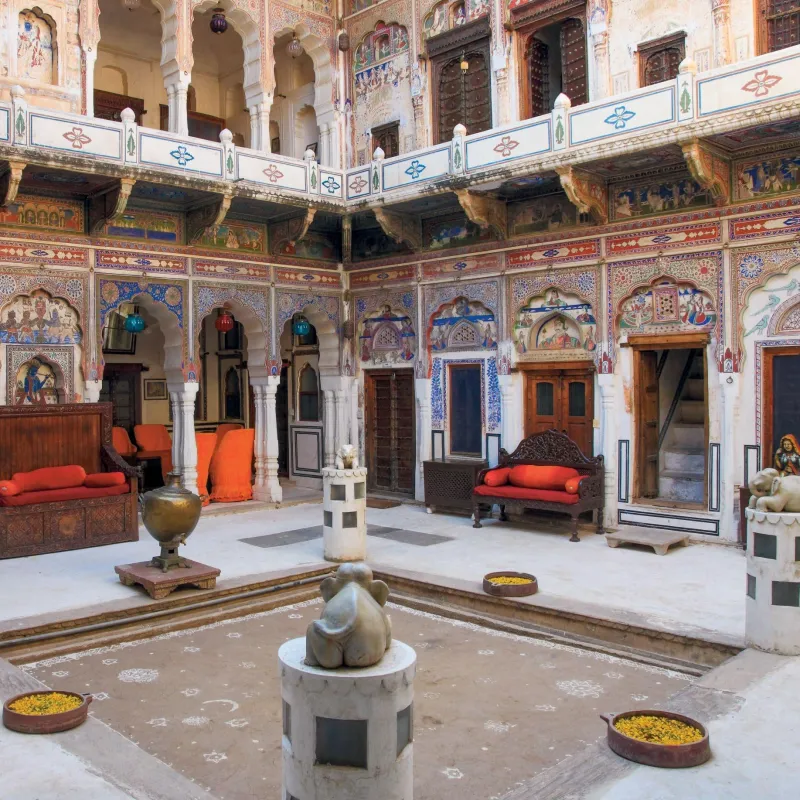
Photo: executive meditation ancient Indian courtyard philosophy retreat luxury wellness, via assets.isu.pub
Somewhere between a Series C close and a board restructuring, a founder we will call Marcus — a San Francisco-based CEO of a mid-sized enterprise software company — found himself sitting cross-legged in a private courtyard in Hyderabad's Old City, listening to a scholar of Vedantic philosophy explain the concept of viveka, the Sanskrit term for discernment. Marcus had not come to India seeking enlightenment. He had come, in his own words, because he had tried everything else.
"I had done the executive coaching, the breathwork, the float tanks," he said afterward. "What I hadn't done was sit with something that was actually old enough to have perspective on the problems I was carrying."
Marcus is not an outlier. He is, increasingly, representative of a quiet but significant cultural shift happening at the very apex of American business leadership.
The New Status Symbol Has No Price Tag
For the past decade, the wellness industry has successfully colonized the executive class. Meditation apps, cold plunge protocols, biometric wearables, and high-end retreat centers have all had their moment as the performance optimization tool of choice among America's ambitious professional elite. But something is shifting at the very top of that hierarchy.
Among founders managing companies valued north of a billion dollars, among the C-suite executives whose decisions move markets, a growing number are expressing a specific kind of fatigue — not with wellness itself, but with its commodification. They are seeking something that cannot be delivered through a subscription app or a weekend at a luxury spa in Sedona. They are seeking depth.
Hyderabad, with its extraordinarily layered intellectual and spiritual heritage — a city where Sufi mysticism, Hindu philosophy, and centuries of cosmopolitan scholarship coexist within walking distance of one another — has emerged as a destination capable of providing exactly that. For the discerning few who engage it properly, the city's contemplative traditions offer something the wellness industry has largely failed to deliver: a genuinely rigorous encounter with the mind.
What Hyderabad's Philosophical Tradition Actually Offers
The Deccan region, of which Hyderabad is the historic heart, has been a center of philosophical and contemplative scholarship for centuries. The city's culture reflects the intellectual legacy of the Nizams, who presided over one of the most sophisticated courts in the subcontinent and actively patronized scholarship across religious and philosophical traditions. That legacy persists today in the form of living scholars, active dargahs, and institutions dedicated to classical Indian philosophy that remain largely unknown to the Western world.
For visiting American executives, a properly curated engagement with this tradition looks nothing like the generic yoga retreat or mindfulness workshop that the wellness industry has trained them to expect. It may involve extended private sessions with a practicing philosopher trained in Advaita Vedanta or Kashmir Shaivism. It may involve guided contemplative walks through the lanes of the old city with a cultural historian who can translate the architectural and social environment into a coherent philosophical narrative. It may involve an evening in a Sufi khanqah — a gathering space — where the practice of dhikr, meditative remembrance, offers an encounter with concentration and presence that no secular mindfulness curriculum has yet approximated.
The common thread is not religion. It is rigor. These are not passive experiences designed to make a visitor feel briefly serene. They are intellectually demanding engagements with systems of thought that have been refined over millennia to address precisely the questions that high-stakes decision-makers carry: How do I act decisively in conditions of radical uncertainty? How do I distinguish signal from noise — within markets, within organizations, within my own cognition? What is the relationship between stillness and effective action?
The Neuroscience Is Catching Up
For executives who require empirical scaffolding before they will engage with contemplative practice, the research landscape has become increasingly supportive. Studies published in journals including NeuroImage and Psychological Science have documented measurable changes in the prefrontal cortex — the region associated with complex decision-making, emotional regulation, and long-range planning — following sustained meditation practice. Research from Harvard Medical School has linked contemplative practice to reductions in activity in the default mode network, the neural system associated with rumination, distraction, and the kind of catastrophizing that tends to accompany high-pressure leadership environments.
More specifically relevant to executive function, research from the University of California has found that brief but intensive meditation retreats produce statistically significant improvements in sustained attention and working memory — the cognitive resources most directly depleted by the meeting-dense, notification-saturated reality of modern executive life.
What Hyderabad's classical traditions offer, in this context, is a depth of practice that brief app-based interventions cannot approximate. A three-day immersive engagement with a qualified teacher, conducted in an environment that has been specifically curated to minimize distraction and maximize contemplative depth, produces a qualitatively different neurological and psychological result than twenty minutes of guided breathing before a morning standup.
Profiles in Stillness
The executives who have engaged Hyderabad's contemplative traditions through curated concierge programs describe outcomes that cluster around a few consistent themes.
The first is decision-making clarity — a reduced tendency toward reactive judgment and an increased capacity to hold ambiguity without forcing premature resolution. One CFO described it as "learning to be comfortable in the gap between the question and the answer, which turns out to be where most of the important thinking actually happens."
The second is leadership presence — a quality that is widely discussed in executive coaching circles but rarely defined with precision. Several participants described emerging from their Hyderabad immersions with what one founder called "a different relationship to the room" — a quality of attention and groundedness that colleagues noticed before the executive had said a word about where they had been or what they had done.
The third, perhaps most surprisingly, is creative expansion — the generation of genuinely novel strategic thinking in the weeks following an immersion. This aligns with research suggesting that the default mode network, when properly regulated rather than chronically overactivated, becomes a source of integrative, associative cognition — the kind of thinking that connects disparate ideas into new configurations.
The Concierge Difference
The distinction between a generic spiritual tourism experience and a genuinely transformative executive immersion lies almost entirely in the quality of the curation. Hyderabad's contemplative resources are real and extraordinary — but they require navigation. Not every practitioner who presents as a teacher offers the intellectual rigor that a discerning executive requires. Not every venue that markets itself as a retreat center provides the combination of privacy, depth, and cultural authenticity that makes this kind of experience genuinely valuable.
Hyderabad VIP Service constructs these immersions from the inside out — beginning with a detailed understanding of each client's cognitive style, leadership challenges, and existing relationship with contemplative practice, then designing a program that engages the city's genuine philosophical heritage in a manner calibrated to produce specific, measurable outcomes.
For Marcus, the outcome was unambiguous. He returned to San Francisco, navigated a complex board transition that had been troubling him for months, and described the resolution as having emerged almost effortlessly from a quality of clarity he had not previously possessed.
"I didn't find peace in Hyderabad," he said. "I found precision. Which, it turns out, is exactly what I needed."