Measured Across the Ocean: The Hyderabad Cutters Behind America's Quietly Perfect Wardrobes
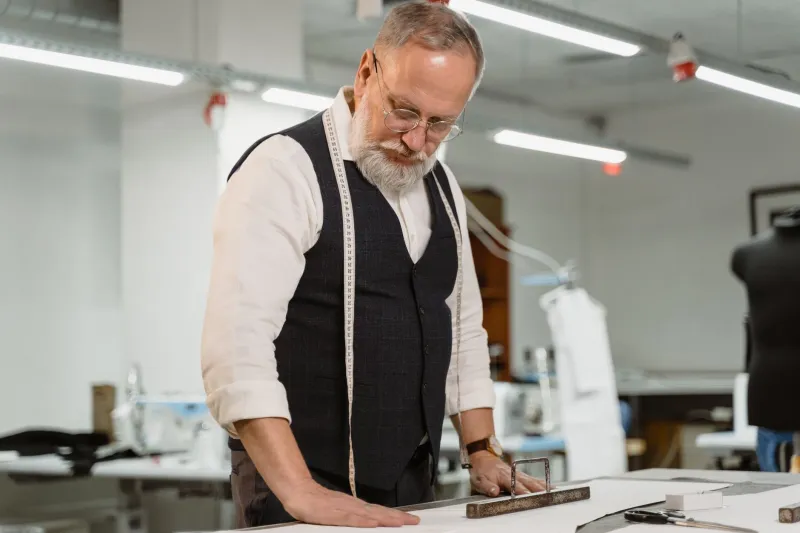
In a courtyard workshop a short drive from Hyderabad's old city, a master cutter runs a thumb along a page of a cloth-bound ledger. The entry dates to 1987. It records the chest, sleeve, and posture notes of a man who was then a young executive visiting from Boston. The same ledger now holds his son's measurements, and — as of last spring — his grandson's.
This is the kind of continuity that a growing number of American families have decided money alone cannot buy. And it is why a quiet current of bespoke tailoring now flows between the United States and the City of Pearls.
A Pedigree Older Than Savile Row's Client Books
Hyderabad's finest ateliers trace their lineage to the darzi tailors who served the Nizams of Hyderabad State, rulers whose courts set standards of dress that rivaled any in the world. The sherwanis, angarkhas, and formal coats produced for that court demanded a precision of drape and an intimacy between cutter and client that became hereditary craft knowledge, passed from father to son across generations.
That inheritance survives in a small number of workshops today. These are not boutiques with waiting-room espresso machines. They are ateliers where the head cutter may still draft a pattern freehand from a dozen body measurements and a two-minute conversation about how a man sits, stands, and gestures.
American clients — many from families whose names appear on foundation boards rather than billboards — have begun treating access to these cutters as a form of cultural capital. One New York family office principal describes his Hyderabad wardrobe as "the only clothing I own where the tailor knows things about me my doctor doesn't."
The Ledger as Legacy
What distinguishes these Hyderabad houses from their European counterparts is not merely skill but record-keeping. Decades of client ledgers — some spanning three generations of a single family — document not just measurements but preferences, postural quirks, and even notes on how a client's tastes evolved after a marriage, a loss, a promotion.
When an American heir flies in for his first fitting, he is often measured against a record that already contains his father. The cutter will remark that the young man stands like his grandfather. For families preoccupied with lineage and continuity, this is not a service. It is an archive.
Several families now schedule their Hyderabad fittings around the same week each year, pairing the appointment with visits to the city's pearl markets and private artisans. The wardrobe delegation becomes, in effect, an annual pilgrimage — one that concierge firms in the city have learned to orchestrate down to the car schedule.
Measurements by Mail, Fittings by Video
Not every client makes the journey. A substantial share of the American business is conducted remotely: measurements taken by a trusted local fitter or a previous tailor, transmitted confidentially, followed by garment construction over weeks and a final video consultation to assess drape.
The ateliers have adapted with characteristic discretion. Garments travel in unbranded packaging. Invoices are issued through intermediaries. One second-generation cutter in Abids, whose grandfather tailored for the Nizam's household staff, estimates that half his current American volume comes from referrals passed between families rather than any form of marketing — because he does none.
Why Not Savile Row?
The obvious question deserves an honest answer. London's great houses remain superb, and no serious client disputes it. But American devotees of the Hyderabad cutters cite three advantages.
First, time. A Hyderabad commission moves at the pace of craft rather than the pace of a waiting list measured in years. Second, relationship. The cutter who holds your father's ledger will alter your jacket without being asked, because he already knows how your shoulder changed since last winter. Third, and least quantifiable: provenance. A garment from a workshop that once served a royal court carries a story that resonates in rooms where stories are the only currency that cannot be purchased outright.
As one third-generation client from Chicago put it: "Anyone can buy Savile Row. Not everyone can say their tailor's grandfather dressed a prince."
The Discreet Expansion
The ateliers themselves remain ambivalent about growth. Several have declined offers from American luxury groups seeking partnerships. The head of one family workshop explained his reasoning plainly: a ledger can hold only so many names before it stops being a relationship and becomes a database.
For now, access flows through word of mouth, through Hyderabad's concierge networks, and through the families themselves — the way the best things in the City of Pearls always have. The result is a wardrobe few will ever see and fewer will ever understand, cut by hands that have been measuring the same families for longer than most American fortunes have existed.
That, for a certain kind of American family, is the point.