Hand-Forged and Unrepeatable: Why America's Serious Collectors Are Commissioning Locks from Hyderabad's Fifth-Generation Keymakers
The most exclusive security system in America right now cannot be hacked, cannot be cloned, and cannot be replaced — not even by the man who made it.
It hangs, at this moment, on a wine cellar door in Napa Valley: a brass lock weighing nearly four pounds, forged by hand in a workshop a few hundred yards from Hyderabad's Charminar. There is exactly one key in existence. When its owner wants a second set of hands to open the room, he must be present. There is no override, no reset, no customer service line. That absence is precisely the point.
The Guild That Never Took an Apprentice from Outside the Family
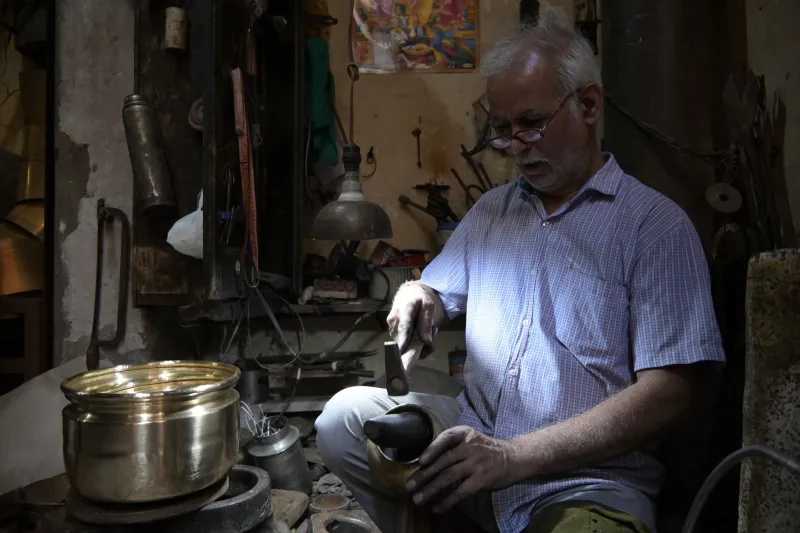
Hyderabad's locksmith traditions trace their lineage to the Qutb Shahi era, when the city's metalworkers supplied the Nizam's treasuries with locks designed to defy every tool of their age. What survives today is not an industry but a handful of families — fifth-generation keymakers, some working from the same stone-floored workshops their great-grandfathers occupied — who still practice a discipline most of the world abandoned sometime around 1920.
Their craft rests on a principle that sounds almost contradictory: the lock is built so that even its maker cannot reconstruct the key. The wards are cut by hand against a wax impression taken at installation, filed to tolerances that vary from lock to lock, and never recorded. No blueprint exists. No pattern is retained. When the final key is polished and handed over, the knowledge of the lock's inner geometry effectively dies with the installation.
Collectors call these "unrepeatable" systems. The guilds themselves are more matter-of-fact. "We can make you a beautiful lock tomorrow," one master keymaker told us through a translator, gesturing at a half-finished chamber lock on his bench. "I cannot make you this lock again. That is not a flaw in the work. That is the work."
From First Inquiry to Installation: One Collector's Six-Month Journey
The American clients who find these workshops rarely arrive by accident. They are typically referred through a small circle of estate architects, wine consultants, and art handlers who have worked with Hyderabad's craft networks before — the same quiet referral economy that has made the city's concierge infrastructure a fixture among US family offices.
Consider the arc of a typical commission, which we followed from initial contact to final fitting for a collector based outside Boston.
Week one: the conversation. The process begins not with a purchase order but with a discussion of what the room protects. A cellar of first-growth Bordeaux requires different considerations than a gallery of works on paper, and the guilds ask questions most security vendors never think to pose: How often is the room entered? Who else has standing access? Will the owner be present at every opening, or must the system accommodate a household manager?
Weeks two through ten: the forging. The lock body is cast in brass — often recycled from older fittings the client may supply for sentimental reasons — then filed, drilled, and fitted entirely by hand. Clients receive photographs at intervals, and many describe this as the most engaging part of the process: watching a mechanism take shape that will exist nowhere else on earth.
Weeks twelve through twenty: the fitting. This is where Hyderabad's concierge layer becomes essential. Door hardware, jamb reinforcement, and hinge work must be completed to the lock's specifications, and the guilds insist on overseeing installation personally. For American clients, this typically means arranging travel for one or two craftsmen, along with the visas, logistics, and discretion that such a trip requires. It is exactly the kind of cross-border choreography a private concierge practice handles daily.
The handover. The key is presented in a cloth wrap, the wax impression destroyed in front of the client, and the workshop's records — such as they are — closed. From that moment, the lock belongs to one person and answers to one object.
Why Mechanical Secrecy Became the New Status Symbol
The irony is not lost on anyone in this trade: the wealthiest generation of Americans in history, surrounded by biometric scanners and encrypted everything, is spending six figures on hand-filed brass.
But the logic holds. Digital security is universal — the same fingerprint reader protects a billionaire's pantry and a suburban front door, and every digital system, by definition, has a key that exists somewhere in code. A guild lock has no such shadow. There is no vendor with a backdoor, no firmware to patch, no breach to fear because there is nothing connected to breach.
For collectors whose wine cellars and galleries hold assets worth more than the houses around them, the appeal is partly practical. But talk to enough of these clients and a second motive emerges, one that sounds more familiar to anyone who watches the luxury markets: provenance and story. A Napa collector can tell dinner guests that his cellar is protected by a lock forged by a family that supplied the Nizam's treasury, that the key was carried across the ocean in a leather case, and that no other key to any other room on earth will ever open it. No certificate of authenticity from a Swiss vault manufacturer can compete with that narrative.
There is also a quieter, more American motive: control. Several clients describe the guild lock as the one element of their security posture that requires no trust in any third party — no monitoring firm, no software company, no cloud. In a decade of escalating data breaches, that independence has become its own form of wealth signaling.
The Waiting List Is the Product
Demand now outruns supply by a wide margin. The most sought-after workshops accept a limited number of international commissions each year, and Hyderabad VIP Service maintains the relationships — and handles the logistics — that turn a centuries-old craft into a seamless transatlantic project.
For American collectors weighing the investment, the calculus is straightforward. The finest commercial vault hardware is excellent. But it is also, by definition, manufactured. The guild lock is not. It is a singular object, the product of a knowledge system that cannot be scaled, franchised, or replicated — the same qualities that make a rare pearl or a commissioned painting valuable.
In the City of Pearls, rarity has always been the point. It turns out the same is true of the keys.