The Collector's Edge: Inside Hyderabad's Private Art World and the American Investors Who Are Discovering It
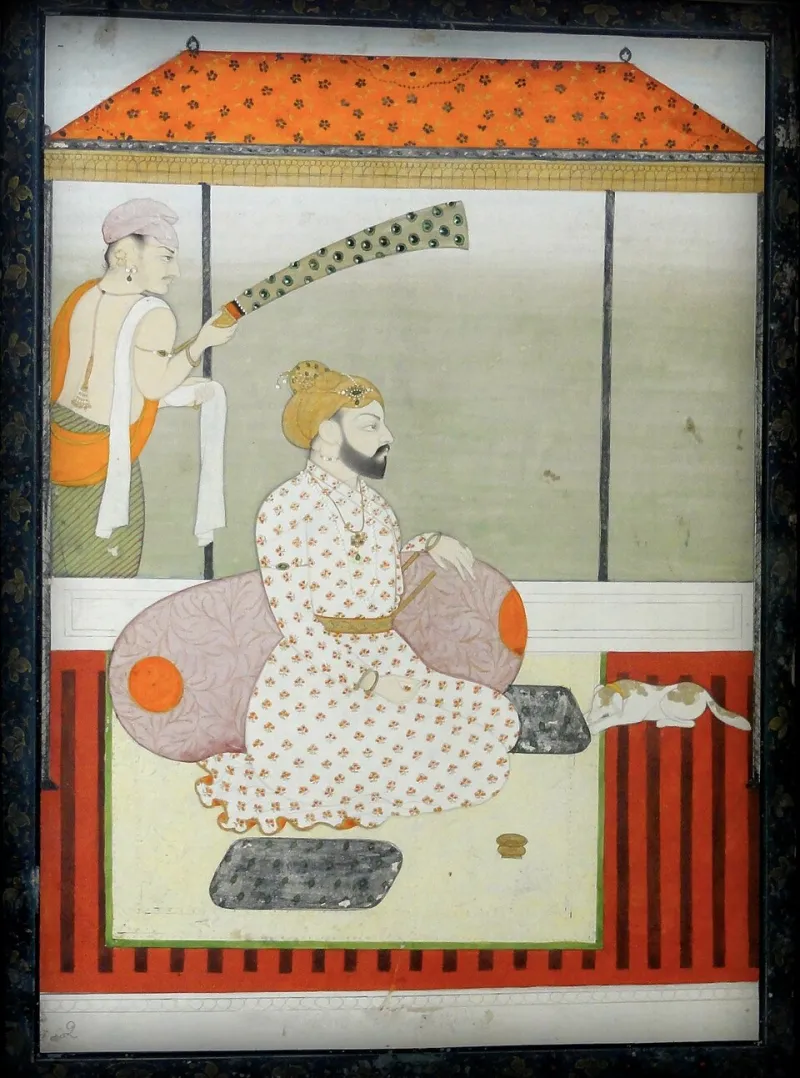
Photo: possibly the family workshop (or atelier) of Nainsukh of Guler, Public domain, via Wikimedia Commons
A Market That the Art World Has Not Yet Priced In
When American collectors think of international art markets, the conversation tends to orbit predictable capitals — London, Paris, Hong Kong, New York. These are markets defined by auction house dominance, gallery prestige hierarchies, and price transparency that, while reassuring, also reflects a competitive landscape in which the most significant works have already been identified and bid to their ceiling.
Hyderabad operates by different rules. It is a city with one of the most extraordinary concentrations of artistic heritage in South Asia — a legacy built across centuries of Qutb Shahi and Nizami patronage, a tradition of miniature painting that influenced courts from Persia to the Mughal empire, and a contemporary scene producing artists whose international recognition is growing faster than the market has yet absorbed. For the disciplined collector with access to the right channels, this disparity between cultural significance and market valuation represents an uncommon opportunity.
The operative phrase, of course, is access to the right channels.
The Invisible Architecture of Hyderabad's Art World
Unlike the gallery districts of Chelsea or the auction preview rooms of Christie's Rockefeller Center, Hyderabad's most consequential art transactions do not occur in public-facing venues. The city's serious collectors — descendants of Nizami nobility, industrialist families who have been acquiring for generations, and a new cohort of technology-sector wealth — operate within a private network that is, by design, largely invisible to outsiders.
This is not exclusivity for its own sake. It reflects a cultural orientation in which significant objects — particularly those with historical or familial provenance — are not commodities to be marketed but inheritances to be stewarded. When a family in the old city decides to part with a Deccani miniature that has been in their possession for two centuries, they are not listing it on an online platform. They are having a conversation with someone they trust.
For an American collector arriving without established relationships, this architecture is effectively impenetrable through conventional means. Standard gallery visits will yield aesthetically pleasing work. They will not yield access to the pieces that define the market's ceiling.
What Serious Collectors Are Actually Seeking
The American high-net-worth individuals who approach Hyderabad VIP Service with collecting objectives tend to fall into several distinct profiles, each with different priorities.
The first group consists of established collectors who have built significant holdings in Western contemporary art and are seeking meaningful diversification — both aesthetically and as a hedge against the concentration risk inherent in any single regional market. For these collectors, Hyderabad's historical works, particularly Deccani and Golconda school miniatures, offer both scholarly significance and a provenance narrative that enhances the overall coherence of a serious collection.
The second group comprises collectors who are earlier in their acquisition journey and are deliberately seeking a market where their capital can secure objects of genuine rarity before broader institutional attention arrives. The logic here mirrors what sophisticated investors have applied to emerging equity markets: entry before the consensus trade.
A third, smaller group approaches collecting through a cultural investment lens — individuals who have personal or professional connections to India and wish to build holdings that reflect that relationship with appropriate depth and intentionality.
All three profiles require the same foundational asset: trusted, knowledgeable, locally embedded access.
The Authentication Imperative
No responsible discussion of historical Indian art acquisition can proceed without a direct engagement with the question of authentication. The market for Deccani miniatures, Nizami-era decorative arts, and pre-modern Indian objects has, historically, been complicated by provenance gaps, export restrictions, and a cottage industry of sophisticated reproductions.
This is precisely why the role of a credentialed local intermediary is not a convenience — it is a necessity.
Hyderabad VIP Service maintains working relationships with a select group of authentication specialists: academic art historians affiliated with institutions including Osmania University and the Salar Jung Museum, conservators with decades of hands-on experience with Deccani works, and legal advisors who specialize in the cultural property frameworks governing international art transactions between India and the United States.
Before any acquisition facilitated through our network proceeds to the negotiation stage, the work undergoes a rigorous documentation process. This includes physical examination, comparative analysis against catalogued works, provenance research, and a legal review of export eligibility under India's Antiquities and Art Treasures Act. American collectors working through our service receive a complete documentation package that satisfies the due diligence standards of major U.S. auction houses and institutional appraisers.
Private Viewings and the Collector's Itinerary
For clients who travel to Hyderabad with acquisition objectives, Hyderabad VIP Service constructs a curated viewing itinerary that operates entirely outside the public-facing gallery circuit. A typical engagement might include a private morning session with a third-generation dealer whose family has specialized in Qutb Shahi-period decorative arts for sixty years, followed by an afternoon viewing at a private residence where a family collection is being selectively offered for the first time.
The Salar Jung Museum — one of the largest single-person art collections ever assembled and a landmark of Hyderabadi cultural heritage — provides essential scholarly context for any serious collecting visit. Our relationships with museum scholars allow for private curatorial discussions that significantly deepen a collector's understanding of period, style, and quality benchmarks.
For those interested in contemporary work, Hyderabad's emerging gallery scene includes several spaces that represent artists whose institutional recognition — in the form of museum acquisitions and international biennale participation — is accelerating. Private studio visits, arranged through our network, allow collectors to engage directly with artists and acquire works before they enter the secondary market.
The Investment Horizon
It would be misleading to frame Hyderabad art acquisition purely as a financial proposition. The most significant works in this market carry cultural weight that exceeds any price-to-earnings analysis. That said, the investment case is not trivial.
Deccani miniatures of documented provenance and strong condition have appreciated materially over the past two decades, driven by growing institutional interest, diaspora collecting, and the broader global reappraisal of non-Western art historical traditions. Contemporary artists emerging from Hyderabad's scene are entering a global market with increasing appetite for Indian art, supported by the expansion of South Asian collecting networks in the United States, the United Kingdom, and the Gulf.
For the collector who enters this market with proper access, rigorous authentication standards, and a long-term perspective, Hyderabad represents something increasingly rare in the contemporary art investment landscape: a genuine opportunity that the consensus has not yet found.
Hyderabad VIP Service exists, in part, to ensure that the right clients find it first.