Rice Paste and Badami Stone: The Deccan Workshops Where America's Fading Family Papers Go to Survive
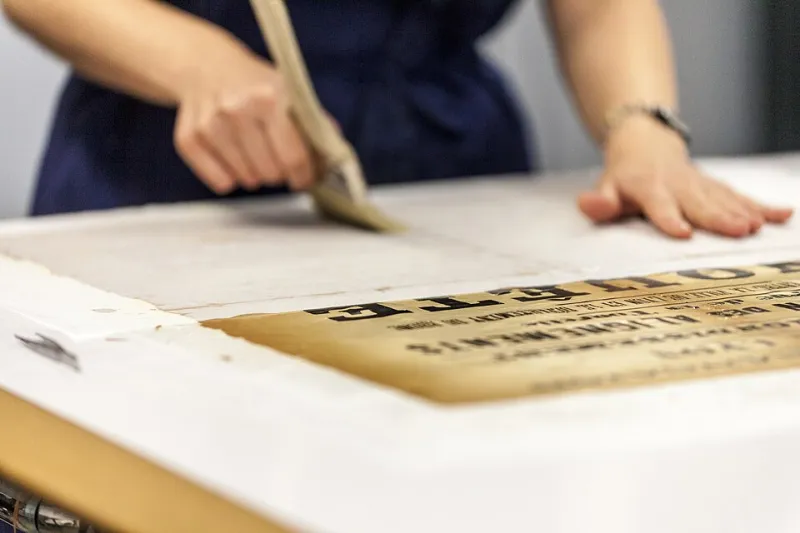
Photo: Laurent Vella, CC BY 4.0, via Wikimedia Commons
The crate arrived at a workshop in Hyderabad's old city on a Tuesday morning, having traveled 8,000 miles from a private library in Connecticut. Inside, wrapped in acid-free tissue by a family archivist who described the shipment as 'the most anxious send of my career,' lay 214 letters written by a Union officer between 1862 and 1865 — documents that had survived four generations of American history only to begin dissolving in the humidity of a New England basement.
The family did not take them to a museum lab. They took them to Hyderabad.
A Craft Older Than the Damage
The Deccan plateau has been conserving paper since long before the United States existed. The courts of Golconda and the Asaf Jahi nizams maintained manuscript ateliers where Persian, Arabic, and Deccani texts were copied, illuminated, and — crucially — repaired using methods passed down through unbroken apprenticeship lines. Those techniques never left. They simply waited.
What distinguishes Deccan paper conservation is material honesty. Where much Western practice leans on synthetic adhesives and mechanical presses, Hyderabad's senior conservators work with wheat and rice starch pastes cooked fresh each morning, handmade mulberry-fiber tissue toned to match each leaf, and flat badami stone slabs used to press leaves back into plane under their own weight over weeks, not hours. Nothing is rushed. Nothing is irreversible.
'American conservation asks how fast can we stabilize the object,' says a senior restorer whose workshop handles commissions from three continents. 'Deccan conservation asks how long will this repair still be reversible in two hundred years. Those are different questions, and they produce different objects.'
Three Families, Three Archives
The Connecticut letters represent one of a growing class of quiet transatlantic commissions. A second family — Gilded Age descendants from Newport — shipped a water-ruined bundle of deeds and shipping manifests from a Rhode Island mercantile house after learning that standard freeze-drying would leave the ink legible but the paper brittle. In Hyderabad, the leaves were separated one at a time under magnification, bathed, mended, and housed in custom clamshell boxes made in the same workshop.
A third commission came from a Texas ranching family whose Spanish-language land grants, some predating statehood, had been folded and refolded so many times that the creases had become tears. The repair required inlaying each fold with hair-width strips of toned tissue — work that consumed eleven weeks. The family's attorney, who coordinated the shipment, put it plainly: 'We were quoted eighteen months and a waitlist by two American institutions. Hyderabad called it routine.'
Why the Work Crosses the Ocean
Part of the answer is capacity. American conservation labs are largely committed to institutional collections; private family archives compete for scarce slots. Part is cost. But the deeper answer is philosophy. Hyderabad's conservators come from a tradition where a manuscript is not an artifact but a living trust — something meant to be read by descendants, not sealed under glass.
That tradition, refined over centuries of monsoon humidity and courtly patronage, treats every repair as a promise to the next generation. For American families watching their oldest papers quietly turn to dust, that promise — delivered with rice paste, badami stone, and infinite patience — is worth an ocean crossing.